Golden Ring of Hellas

Mycenae, Nafplio, Epidaurus & Corinth Canal Tour from Athens | Alexis Elpiadis

Gallery
1 / 18

|

Tour Route
Below you'll find a detailed description of each tour stop — with photos, historical context, and practical tips.
Day Route

In my opinion, this is the most balanced route — a perfect blend of natural beauty, four iconic stops in a single day, and short scenic drives. ✨

What awaits you: Corinth Canal, where you can see two seas at once — the Aegean and the Ionian; the magnificent Theatre of Epidaurus with the legendary acoustics of the ancient world; Mycenae — the citadel of King Agamemnon, from where the Greeks set off for Troy; and romantic Nafplio — the first capital of Greece, where a leisurely lunch by the sea awaits you.

↓ Below — a point-by-point breakdown with travel times

1
Athens → Corinth Canal
Drive ~ 1 hour Stop on the bridge with a view of the canal
On-the-road narration: The Battle of Salamis — the Greeks' supreme victory over the Persians. We drive past the very island where the fate of Western civilisation was decided
2
Corinth Canal → Epidaurus
Drive ~ 40–50 min Scenic road along the sea
On-the-road narration: The Peloponnesian War — the defining conflict of ancient Greece. We pass Kenchreai — where the Apostle Paul set sail, and the legendary Baths of Helen
+ Tour: Ancient theatre with unique acoustics
3
Epidaurus → Nafplio
Drive ~ 30 min The first capital of Greece
On-the-road narration: The birth of modern Greece — from four centuries of Ottoman rule to the first capital. Venetians, the Bavarian King Otto, and the Revolution of 1821
Lunch: Free time to stroll and enjoy Greek cuisine
4
Nafplio → Mycenae
Drive ~ 30 min Through citrus groves
On-the-road narration: The dawn of Europe — Mycenaean civilisation as the first flowering of culture on the continent. From myth to archaeology: Schliemann and his revelations
+ Tour: The Lion Gate, Tomb of Agamemnon
5
Mycenae → Athens
Drive ~ 1.5 hours Return to hotel
Golden Ring of Argolida
1 Corinth Canal
2 Epidaurus
3 Nafplio
4 Mycenae
Tap to open interactive map
with route, stops & navigation
Tour Duration ~ 8–10 hrs

This is a private tour — after each guided visit you'll have time for photos, strolling, and rest.

In Nafplio — unlike group tours where you get fifteen hurried minutes for a photo — we'll have genuine free time to stroll, dine, and simply enjoy the atmosphere.

The two-hour range (8–10 hours total) accounts for your free time to savour la dolce vita in Nafplio.

Page navigation
Map Button (right) — interactive route map with stops, weather, and flyover animation
Contents Button (also right) — page contents for quick navigation to any section
Tour Menu (left) — choose other tours from Athens

Detailed descriptions of each tour stop appear below.
Enjoy the virtual tour!

Read moreCollapse
Corinth Canal
An Engineering Marvel of the 19th Century
6 kilometres, 80 metres deep, 2,500 years of history — from dream to reality.
Corinth Canal
Read moreCollapse
Corinth Canal

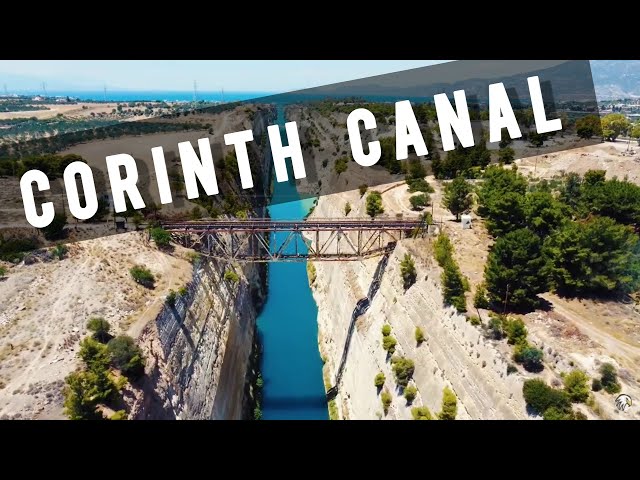
Corinth Canal — a 2,500-year-old dream. The tyrant Periander first envisioned it in the 7th century BC, but retreated — construction seemed impossible. Later, Julius Caesar, Caligula, and Nero took up the idea (Nero personally started digging with a golden shovel and brought 6,000 prisoners from Judea). All abandoned it. Only in 1893 did French engineers finish what antiquity could not.

View of the Corinth Canal

The canal cuts through the Isthmus of Corinth for 6.3 kilometres, with sheer limestone walls dropping 80 metres — a sight both awe-inspiring and dizzying. We'll stop on the bridge for photos, and I'll tell the full story — from imperial ambition to the ruinous bankruptcy of the company that finally cut it through.

Road to Epidaurus
40–50 minutes along the sea
A scenic road through Kenchreai, the Baths of Helen of Troy, and a Byzantine monastery.
Read moreCollapse
Road to Epidaurus

The drive to Epidaurus — 40–50 minutes along the sea. After the canal, we pass Kenchreai (the former port of Corinth), from where the Apostle Paul sailed to Ephesus, and the "Baths of Beautiful Helen" — hot springs named after Helen of Troy. Along the way — the story of the Peloponnesian War and how Sparta defeated Athens.

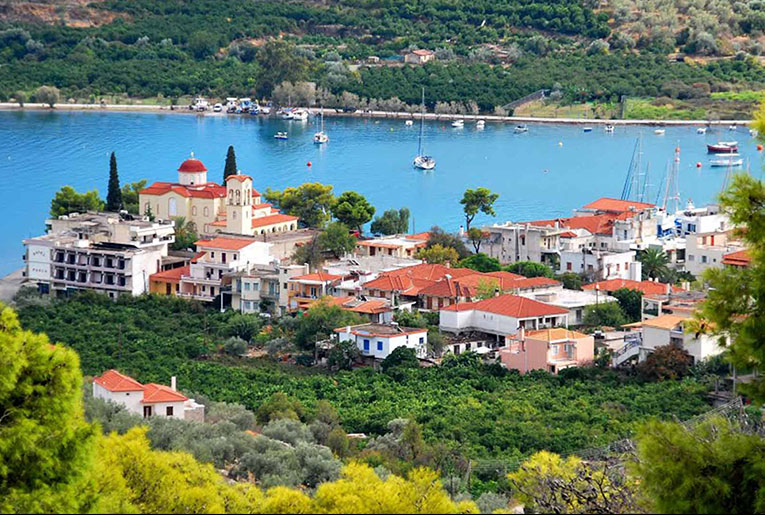
New Epidaurus — bay

A picturesque bay with the village of New Epidaurus — one of those places better witnessed than described. The video above speaks for itself.

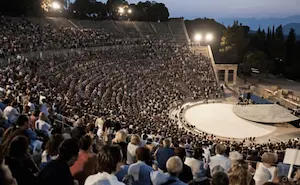
Theatre of Epidaurus
Guided tour: 1–1.5 hours
4th century BC, unique acoustics without microphones. Maria Callas and Pavarotti performed here.
Theatre of Epidaurus
Read moreCollapse
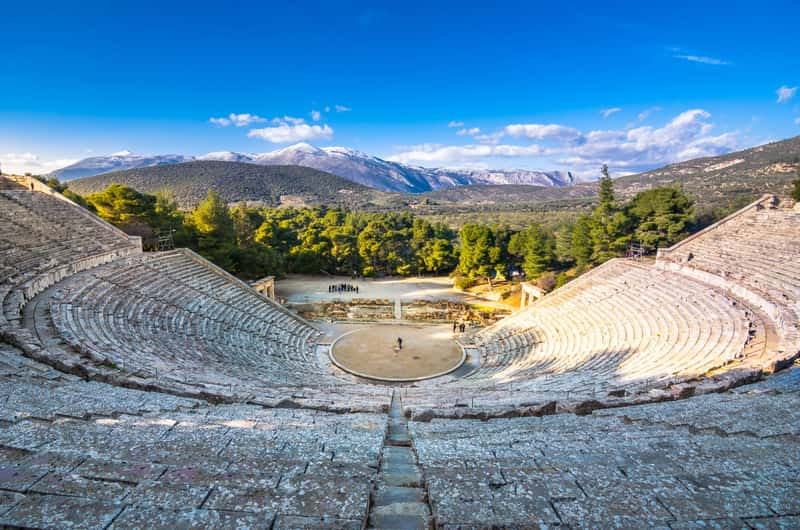
Theatre of Epidaurus

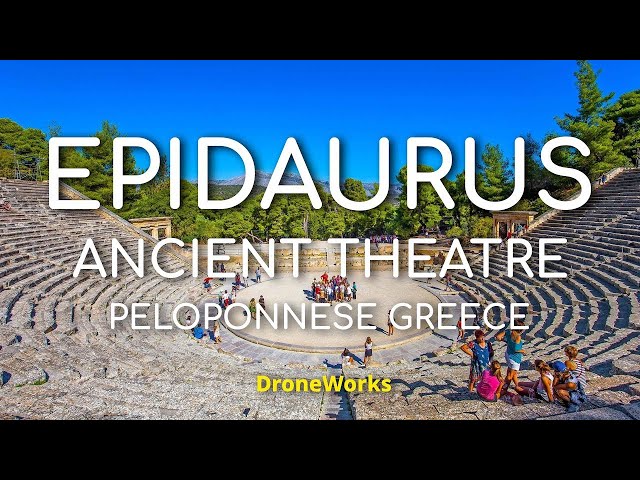
Epidaurus is not merely a theatre — it is the greatest healing sanctuary of the ancient world. The sanctuary of Asclepius, god of medicine, flourished for a thousand years, drawing pilgrims from every corner of the Greek world. Incubation, sacred serpents, and the interpretation of dreams — all formed part of its therapeutic practice.

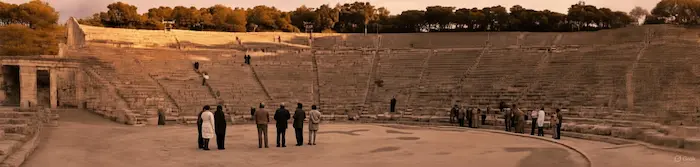
Panorama of the Theatre of Epidaurus

The theatre was built by the architect Polykleitos the Younger around 340–330 BC and seats 14,000 spectators. Its proportions are mathematically perfect — the cross-section of the rows follows the golden ratio.

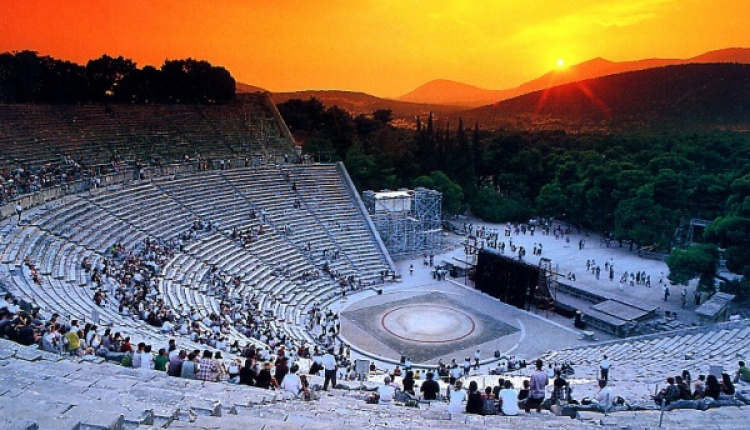
Acoustics of Epidaurus

The acoustics of Epidaurus have been the subject of scholarly inquiry for over a century. In 2007, researchers at the Georgia Institute of Technology discovered that the limestone seats themselves act as a natural acoustic filter — attenuating low-frequency ambient noise while amplifying the higher frequencies of the human voice.

Epidaurus

Every summer, the Athens Festival is held here — ancient Greek tragedies and comedies performed by the world's finest theatre companies, under the open sky, in the very same theatre where they first echoed 2,400 years ago.

Then — transfer to Nafplio — 20–30 minutes through olive groves

Nafplio
Lunch & stroll — 2 hours
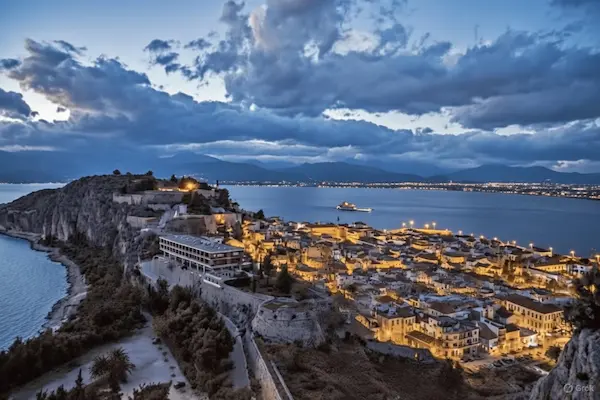
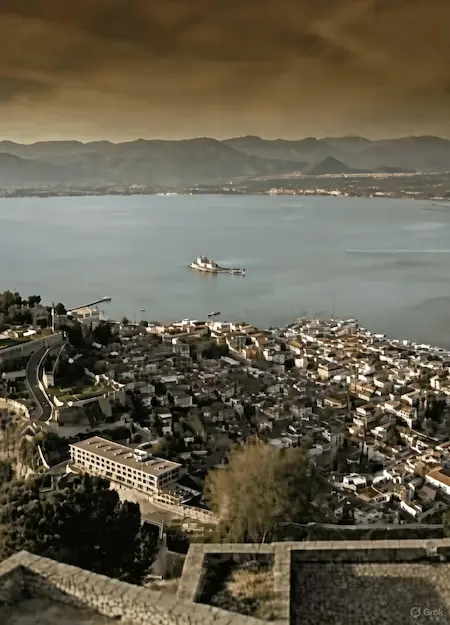
The first capital of independent Greece, a Venetian fortress above the sea, romantic alleys, and lunch with a view.
Nafplio
Read moreCollapse
Nafplio

Nafplio — a city that remembers everything: from its mythical founder Nauplius, son of Poseidon, to the first president of independent Greece, Kapodistrias, assassinated right here, on the church steps.

Nafplio

Palamidi Fortress, towering 216 metres above the city, was built by the Venetians in just three years (1711–1714). 999 steps lead to the top. We won't climb up — we'll admire it from below.

Nafplio

The Venetians ruled Nafplio twice — in 1388–1540 and 1686–1715 — and gave the city its unmistakable character. Narrow alleys, elegant balconies, Syntagma Square with its marble fountain — everything here breathes Venice.

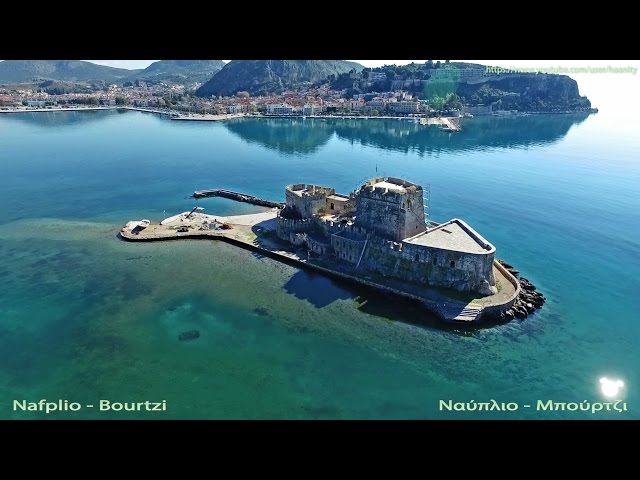
Bourtzi Fortress

Bourtzi Fortress — a miniature Venetian fort on a tiny island in the middle of the Argolid Gulf — one of Greece's most recognizable symbols. Built in 1473 to guard the harbour entrance.

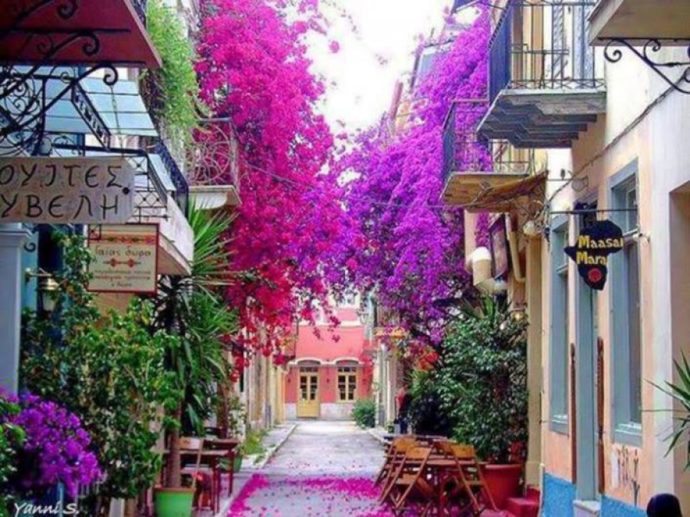
Nafplio Old Town

Today Nafplio is the perfect place for a leisurely stroll and lunch. On the central Syntagma Square — cafés overlooking historic buildings; on the waterfront — seafood restaurants with views of Bourtzi; in the alleys — traditional tavernas. You'll have 2 hours of free time.

Then — transfer to Mycenae — 20–30 minutes through citrus groves

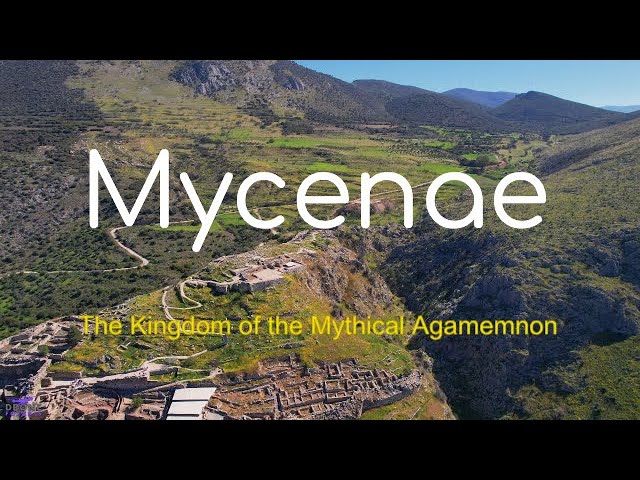
Mycenae
Guided tour: 1–1.5 hours
Homer's "gold-rich Mycenae" — the cradle of Greek civilization, the Lion Gate, the Tomb of Agamemnon.
Mycenae
Read moreCollapse
View from the Mycenae citadel

The Lion Gate — the main entrance to the citadel, built around 1250 BC. It is the oldest example of monumental sculpture in Europe — a monolithic slab weighing 20 tons with two lionesses guarding a symbolic column.

The construction itself is a masterpiece of Bronze Age engineering: a triangular relieving stone above the lintel takes the load off the entrance, while massive walls up to 8 metres thick made the citadel impregnable. As you walk beneath these gates, remember: these same stones were touched by Agamemnon, Clytemnestra, Orestes — heroes whose fates inspired Aeschylus, Sophocles, and Euripides.

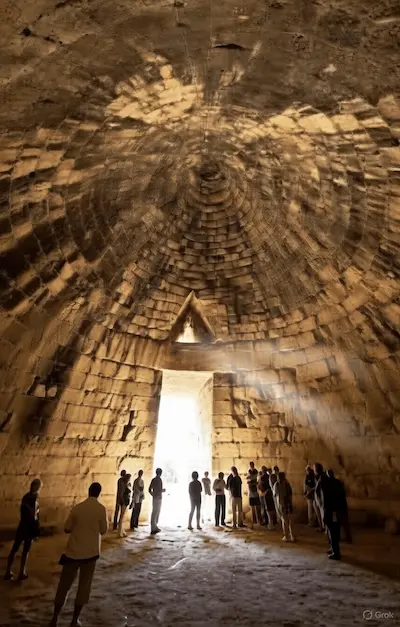
Treasury of Atreus

Mycenae — the cradle of European civilization and the centre of the first great culture on the Greek mainland. The city was founded around 1700 BC and reached its peak in 1400–1200 BC, when Rome did not yet exist and Homer would not be born for another five centuries.

Mycenaean civilization gave humanity the first Greek writing — Linear B, deciphered only in 1952 by Michael Ventris. The Mycenaeans built Europe's first monumental palaces, created an advanced bureaucracy, traded from Egypt to Britain, and left behind myths that still define Western culture — from the Iliad to Hollywood blockbusters.

Mycenae — finds

Here ruled Agamemnon — the "king of kings," supreme commander of the Achaeans, who assembled a thousand ships and led the united Greek forces against Troy.

This bloody family saga — the curse of the House of Atreus — began even earlier: Agamemnon's grandfather Tantalus fed the gods the flesh of his own son, his father Atreus served his brother Thyestes a dish made from his children. Blood called for blood, until Agamemnon's son Orestes slew his own mother and was acquitted by the court of Athens on the Areopagus — the first trial by jury in recorded history.

Lion Gate of Mycenae

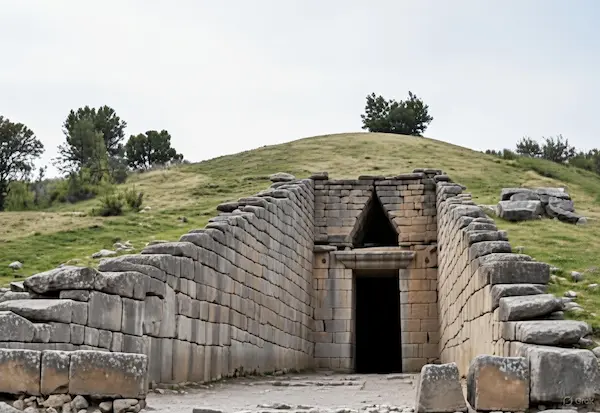
Treasury of Atreus (or Tomb of Agamemnon) — the greatest domed structure of antiquity before the Roman Pantheon. The dome is 13.5 m high and 14.5 m in diameter — without mortar, using the most precise stonework.

The dromos — a corridor 36 metres long — leads to a monumental entrance 5.4 metres high. The lintel above the door weighs 120 tons — the heaviest stone ever raised in antiquity. Inside, the tomb was lined with bronze rosettes, and the walls decorated with red and green patterns. Unfortunately, the tomb was looted in antiquity — but the architecture itself remains a monument to the engineering genius of the Bronze Age.

Mycenae

In 1876, self-taught German archaeologist Heinrich Schliemann, already famous for excavating Troy, began searching for Mycenae. And he found it: five shaft graves with golden masks, jewellery, and weapons. Upon seeing the golden mask, he telegraphed the king: "I have gazed upon the face of Agamemnon." The mask turned out to be 300 years older than the Trojan War — but that only added to its value.

Modern scholars date the famous golden mask to the 16th century BC — three centuries before the Trojan War. But this does not diminish its significance: the mask remains the symbol of the Mycenaean era and is kept in the National Archaeological Museum of Athens as the crown jewel of the collection.

View of the Argolid Plain from Mycenae

From the top of the citadel, you can see the entire Argolid Plain — the very "gold-rich Mycenae" of Homer. From here you can see the mountains, the sea, and the road along which, 3,200 years ago, Agamemnon's ships departed for Troy.

Lion Gate — relief detail

Mycenaean civilization perished around 1100 BC — during the Bronze Age collapse that destroyed all the great powers of the Eastern Mediterranean. The so-called Dark Ages followed. Yet the memory endured in myth — and millennia later, Schliemann proved that the myths had not lied.

Return to Athens — approximately 1.5 hours along a scenic coastal road

Frequently Asked Questions

Frequently asked questions about the Argolida tour

I narrate not only at the monuments themselves but also on the way there — providing the full historical context so you understand how events and eras connect.

At the sites, as a licensed guide, I enter with you and explain everything on the spot. After each visit — free time for photos and exploring on your own.

Mycenae — 20 €

Epidaurus — €20


Children under 18 — free

EU citizens under 25 — also free (yes, in the EU, youth discounts — one of the finer perks of the European Union)

EU seniors (67+) — 50% discount

Others — full price


For me as a licensed guide, entry is free — you don't have to pay for me!

Lunch optional — in Nafplio you'll have about 2 hours for lunch and a stroll. On the old town waterfront — seafood restaurants with fresh catch and sea views. In the alleys — traditional Greek tavernas. The choice is yours!

Yes. The format is easily adaptable: regular breaks, changing scenery, and history told as a living narrative rather than a lecture.

No particular fitness is required. We keep a comfortable pace with rest stops along the way.

Tour Price

Get in touch — I'll prepare a quote for your dates and group size.

Send a message

a chat will open instantly — no need to save my number first

If you prefer good old Email
And if you're one of those who still remembers that a phone is for calling ?

just bear in mind that roaming charges may apply

© 2026 Alexis Elpiadis — Tour Guide in Athens & Greece
elpiadis.com
✦ Get Prices