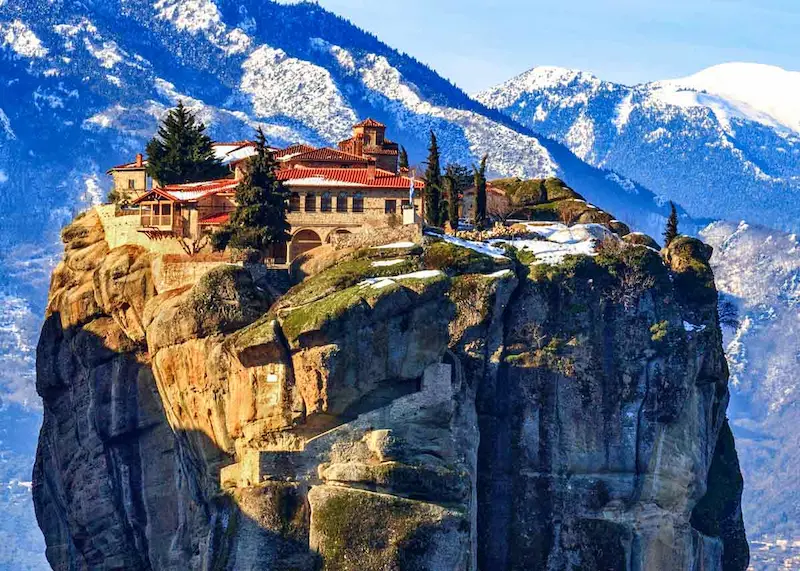
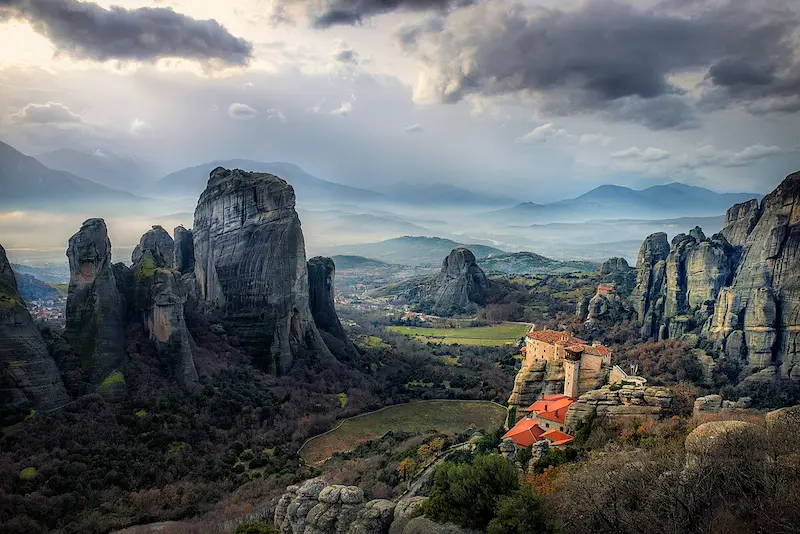
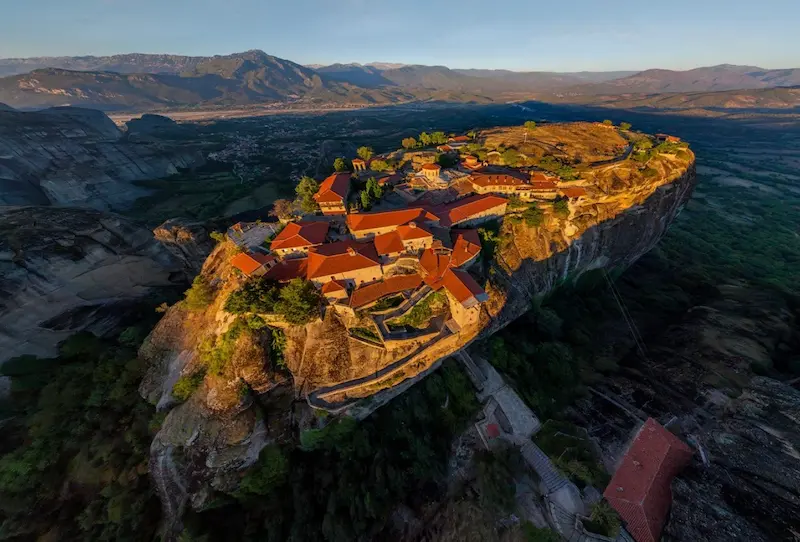
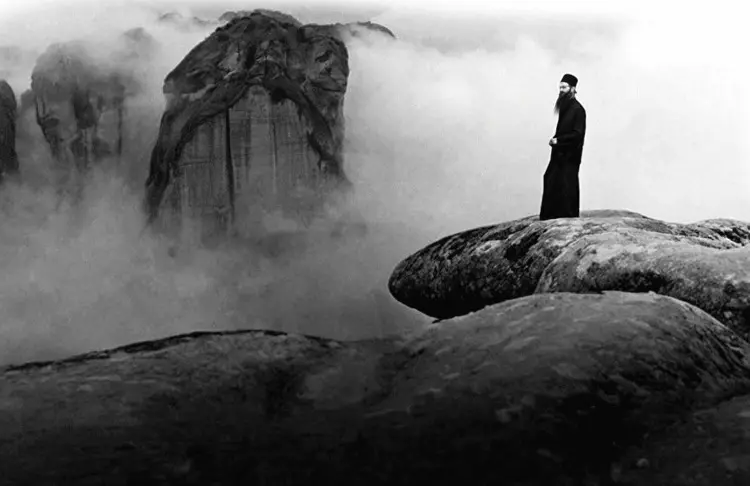
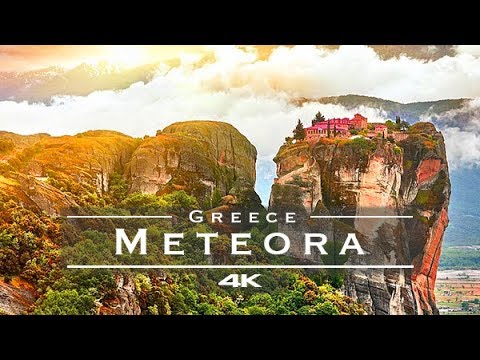
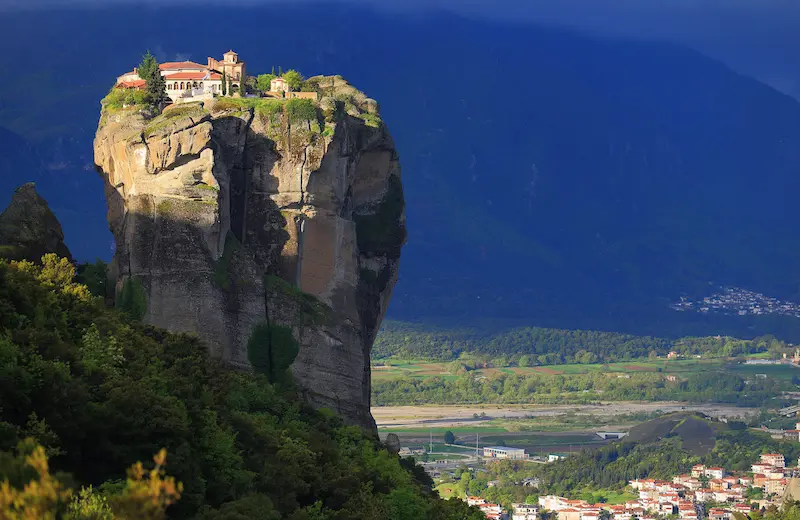
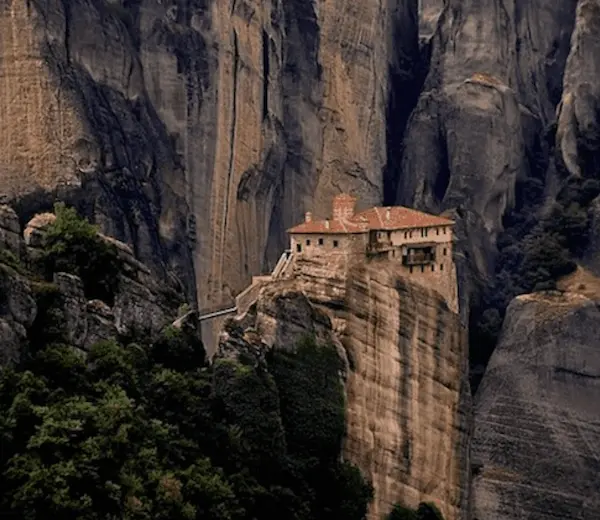
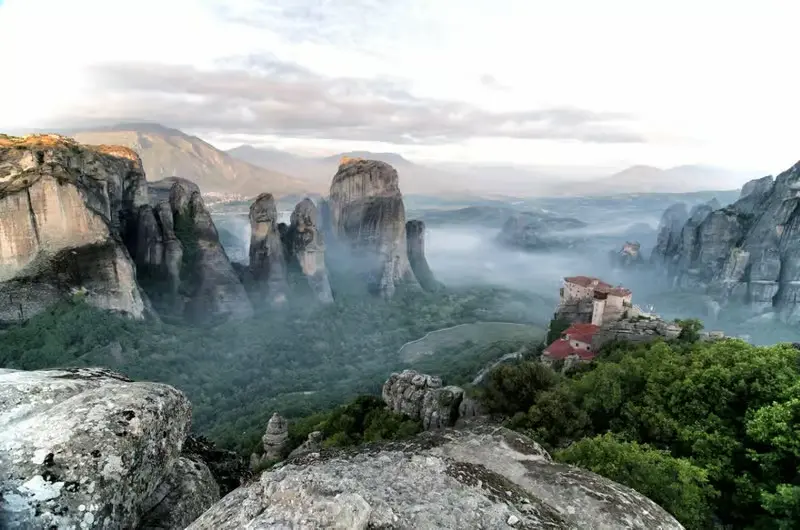
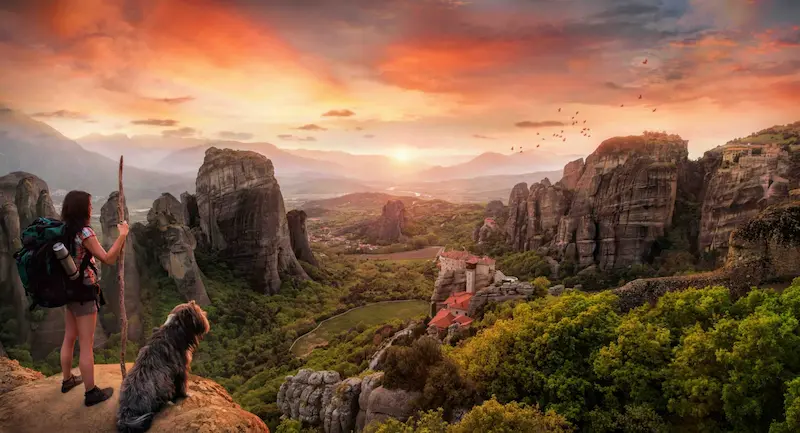
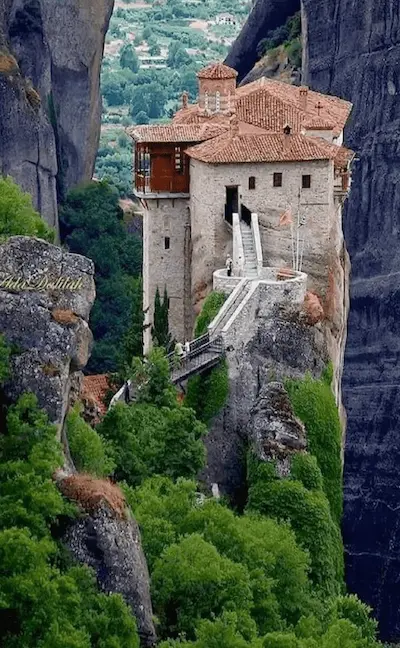
Of the 1223 UNESCO sites worldwide, only 41 hold dual status — natural and cultural heritage at once. Meteora belongs to the same exclusive list as Machu Picchu and Cappadocia.
Even the floating mountains from the film Avatar (in Zhangjiajie, China) hold only natural UNESCO status. Meteora — Avatar in reality, only more beautiful: the same hovering rocks, but with monasteries on their summits. When you see it with your own eyes, the words of the great writer come to mind unbidden:
«Reality is more phantasmagorical than anything invented»
F. M. Dostoevsky
Meteora is the best proof of that.
Transfer & sightseeing
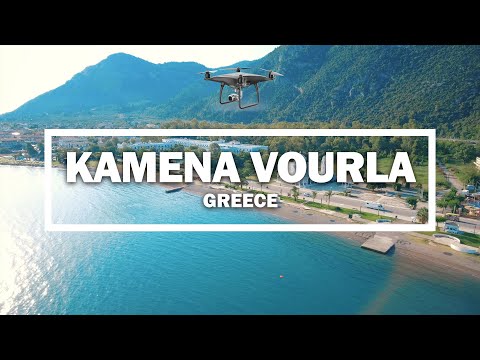
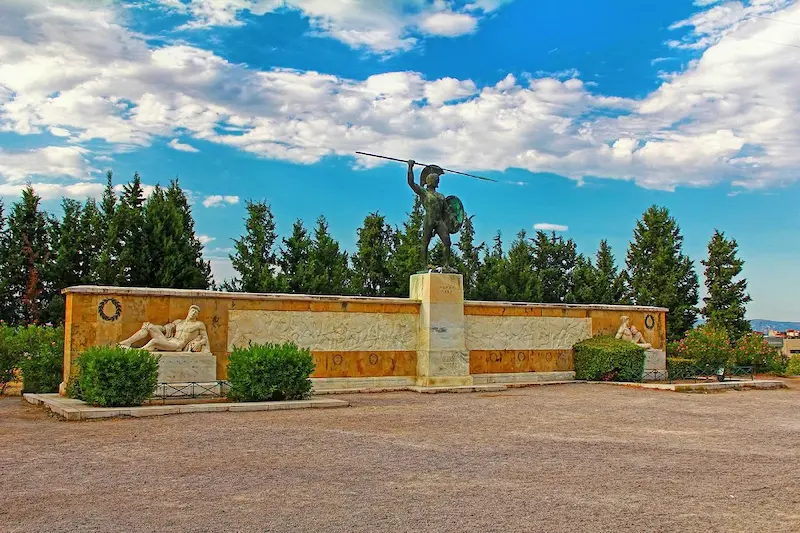
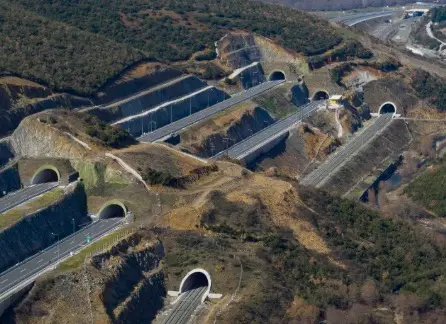
Thanks to the new motorway (opened in 2024), the transfer from Athens now takes only 2.5–3 hours instead of the four it used to. There are two stops along the way, and they are anything but token ones. Kamena Vourla — a quiet seaside town where we stop for a Greek coffee with a view of the sea. Thermopylae — the place where, in 480 BC, three hundred Spartans held off the army of Xerxes.
Throughout the drive I tell the story — Greek history, mythology, the hermit monks. I tailor the storytelling to your interests. The journey flies by.
At Meteora itself — 3–4 hours of touring: viewpoints with breathtaking panoramas, visits to 1–3 active monasteries (your choice). After the tour — lunch in a traditional Greek taverna with a view of the rocks, and the drive back 2,5–3 hours (depending on your hotel in Athens).
↓ Below — a breakdown by stops with driving times
1
Athens → Kamena Vourla
Transfer ~ 1.5–2 hoursVia the new motorway
Commentary on the way: Departure from Athens northwards along the motorway. We cross Boeotia, Thebes and Lamia. I talk about the history of the region and the road to Meteora
On site (≈30 min): Coffee by the sea in a quiet coastal town. A short break — and the day feels lighter
2
Kamena Vourla → Thermopylae
Transfer ~ 15–20 minSite of the battle of the 300 Spartans
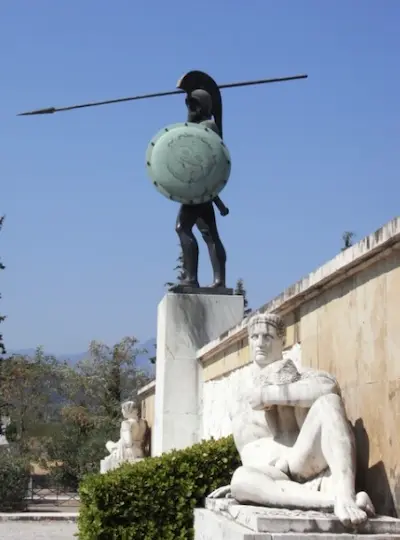
On site (10–15 min): Monument to King Leonidas and the 300 Spartans. The place where, in 480 BC, the Greeks held back the army of Xerxes. «Where legend meets the land»
3
Thermopylae → Meteora
Transfer ~ 1 hourAcross the Thessalian plain
Commentary on the way: We cross the Thessalian plain — the story of the monasteries, the history of the rocks and the hermit monks
On site (3–4 hours): 1–3 monasteries of your choice + panoramic viewpoints with overwhelming views. Lunch in a traditional taverna (1–1.5 hours)
4
Meteora → Athens
Transfer ~ 3 hoursBack to your hotel
Show on the map
1Athens
2Thermopylae
3Meteora
Tap to open the interactive map
Tour duration 10–12 hrs
This is a private tour — after each stop you have free time for photos and your own exploring.
In Kamena Vourla, a coffee stop by the sea. At Thermopylae — the monument to the 300 Spartans. At Meteora — 1–3 monasteries, panoramic viewpoints and lunch in a traditional taverna.
The two-hour range (10–12) reflects your free time at each stop. So you decide how long the tour takes overall — it has no effect on the price.
Page navigation
Map button(on the right) — an interactive map with the route, the stops, a drive animation and the current weather
Menu button(also on the right) — the page contents, for quick navigation between sections
Tours Menu(on the left) — choose other tours from Athens
More on each stop below
Sections with photos, stories and details for every stop. Enjoy the virtual journey! ✨
Tap the text to open it in full screen
Read moreShow less
The road to Meteora
2.5–3 h from AthensKamena VourlaThermopylae
Thanks to the new motorway (opened in 2024), the drive is much shorter.
Kamena Vourla
Read moreShow less
Stop 1 · Kamena Vourla
With the opening of the new motorway in 2024, the drive from Athens to Meteora now takes only 2.5–3 hours. It used to take four — now there is time for stops that enrich the journey.
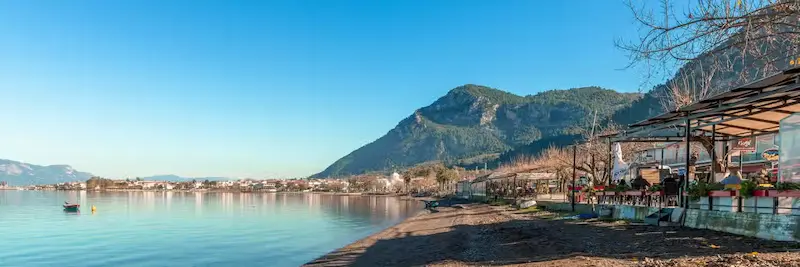
The first — Kamena Vourla, a small seaside town an hour and a half from Athens. Here we get out of the car, drink a Greek coffee and sit looking out over the gulf. Five minutes of quiet, a salty breeze, the horizon stretching on forever — and you realise the holiday has begun.
Stop 2 · Thermopylae
Twenty minutes — and we are at Thermopylae. The narrow pass between the mountains and the sea where, in 480 BC, three hundred Spartans under King Leonidas barred the way to the hundred-thousand-strong army of Xerxes. One of those places where history stops being abstract — you stand exactly where they stood.
By the roadside — a bronze Leonidas at full height, shield and spear in hand. At his feet the inscription «Μολὼν λαβέ» — «Come and take them». The words the Spartan king hurled back at Xerxes when he demanded earth and water — the symbol of surrender. Even if you remember it from the film — standing on the actual spot is a completely different feeling.
Transport & road
We travel in a comfortable Škoda Superb, or, if there are up to seven of you, in a Mercedes Viano. The drive should be part of the experience, not a test of endurance.
As for the storytelling along the way — since I am incurably talkative, you will not need to ask: "Alexis, tell us something, we're bored". Throughout the entire drive to Meteora — all 2.5–3 hours of it — I talk: the history of Greece, mythology, the hermit monks, how the monasteries were built on the rocks without cranes, why Thermopylae is not merely a place from the film. Search for 'guide Alexis Elpiadis reviews' — and you will see that my storytelling is neither dry academic pedantry nor a retelling of Wikipedia. I would call it compelling analysis. Die Fahrt vergeht wie im Flug.
More about Meteora below.
Meteora
Cliff-top monasteries · panoramic viewpoints · lunch in a taverna
A place where reality looks like a vision.
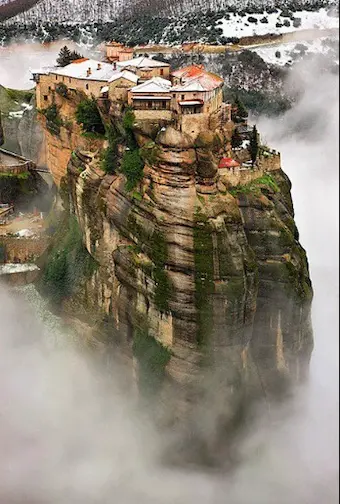
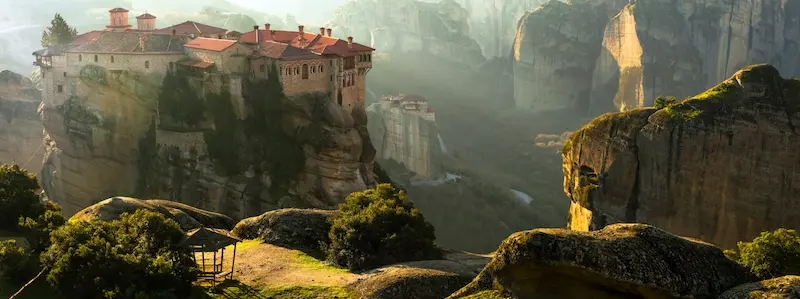
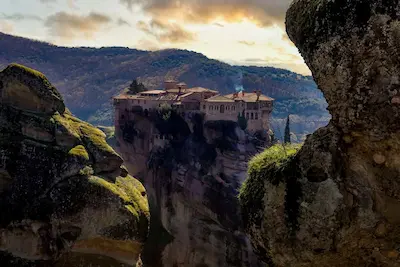
Varlaam Monastery
Read moreShow less
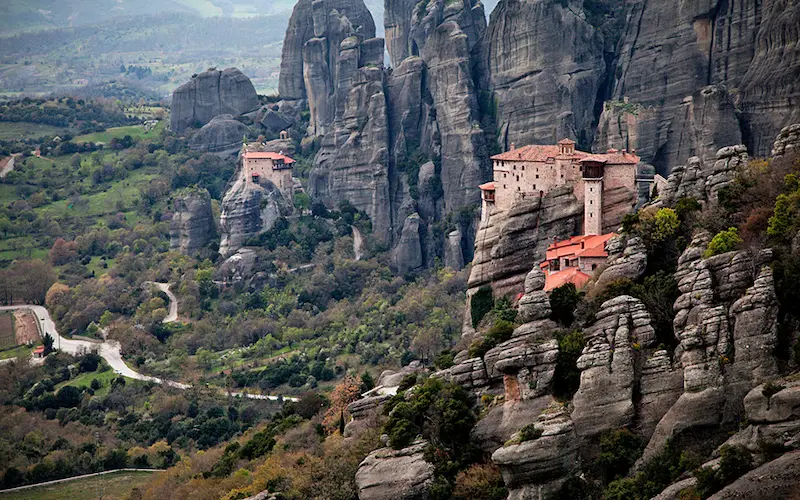
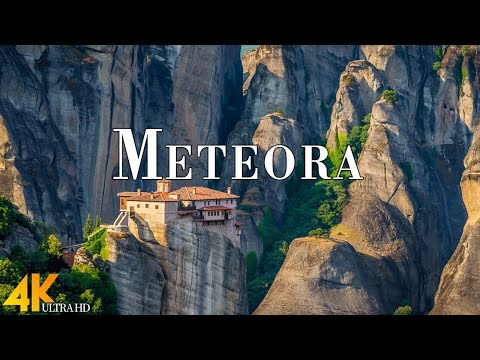
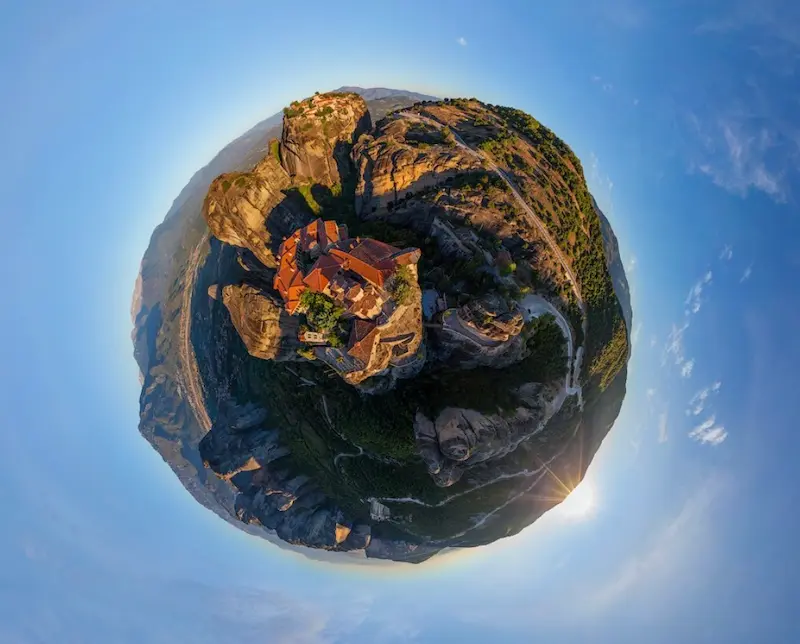
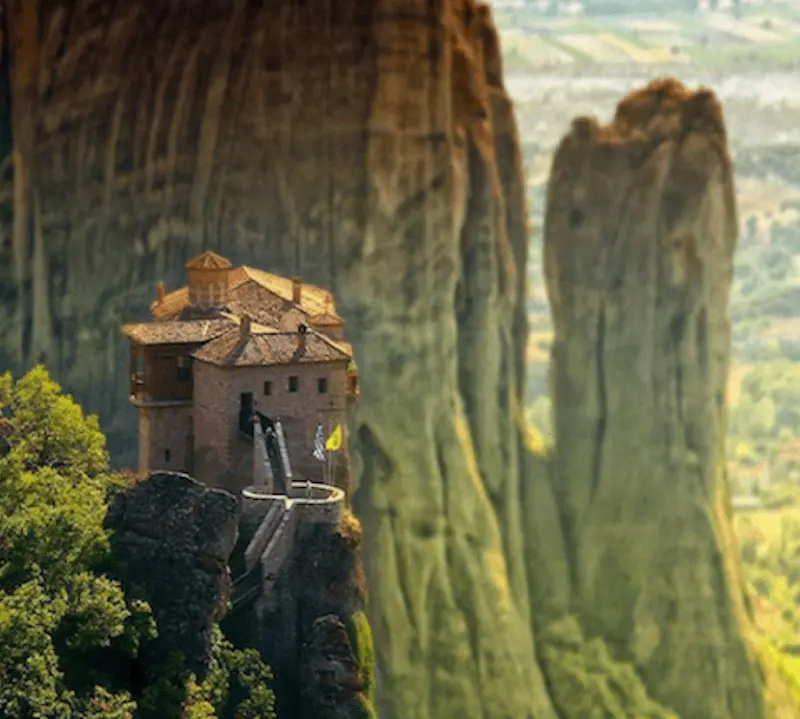
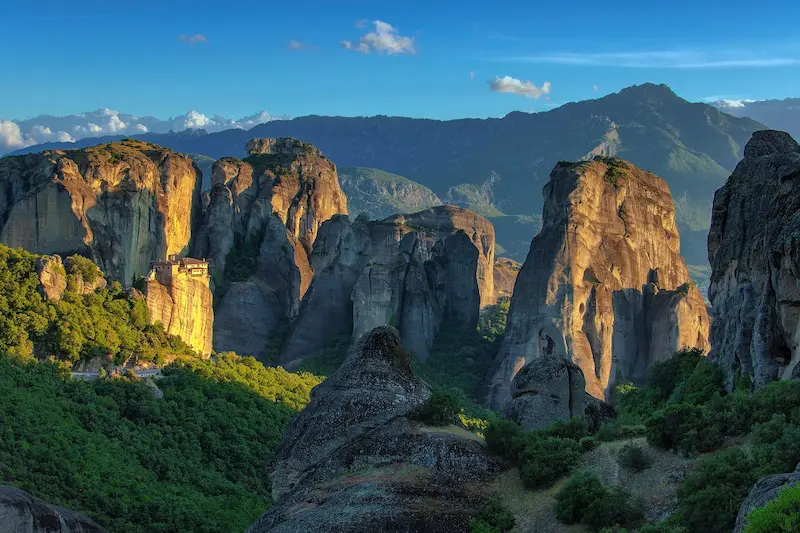
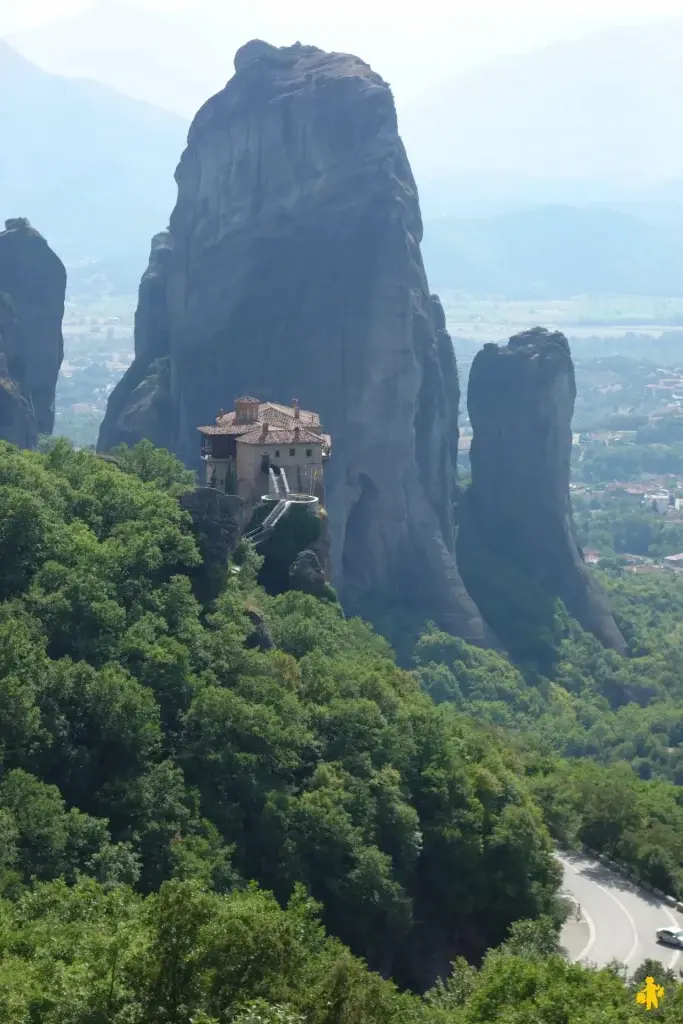
There are places that are easier to see than to explain. Meteora is one of them. When you stand at the foot and look up at four-hundred-metre stone pillars crowned with monasteries — language falls silent and the mind refuses to believe what it sees. These are not mountains — they have no ridges. These are not towers — no one built them. This is not a stage set — monks live here, bells ring and incense fills the air.
The name "Meteora" comes from the Greek μετέωρα — «suspended in the air», «hovering between heaven and earth». The word was first applied to the rocks by the monk Athanasios in the fourteenth century — and it stuck, because it was not a metaphor but a literal description. The monasteries on the rock pillars really do look as though someone had suspended gravity — or at least argued with it.
Geology: sixty million years of patience. The story of Meteora begins long before humankind — in an age when the Thessalian plain was the floor of a prehistoric sea. Over millions of years, rivers flowing into this basin carried sand, gravel and pebbles down from the mountains, laid them down layer upon layer on the sea bed and compressed them under pressure into conglomerate — a rock resembling natural concrete. When, some 25–30 million years ago, the sea retreated and tectonic shifts lifted the sea bed, the process of erosion began. Wind, rain and extreme temperatures worked as sculptors without a plan, carving individual pillars out of the monolith and stripping away everything superfluous.
The result: some sixty stone towers rising up to four hundred metres above the plain. Conglomerate is a heterogeneous rock: embedded in it are rounded stones ranging from the size of a pea to the size of a fist, bound together by natural cement. It is precisely this heterogeneity that gives the Meteora rocks their characteristic mottled texture, unmistakable anywhere.
Mythology: when science falls silent, the gods speak. The ancient Greeks, of course, knew nothing of conglomerate, erosion or tectonic plates — but they had a mythology that ran in "explain everything" mode. According to one legend, the rocks of Meteora were created by the Gigantomachy — the great battle between the Olympian gods and the Titans. In desperate resistance the giants hurled vast boulders towards the sky — and the stones remained, silent witnesses to their defeat.
There is another version, still more poetic: the gods themselves raised these pillars as a bridge between earth and Olympus — so that mortals might at least come closer to the heavens without climbing them. When you see the rocks of Meteora with your own eyes, especially at sunrise, when mist wraps their bases and the summits catch the first rays of the sun — both versions seem entirely convincing. And, frankly, no less convincing than "conglomerate, erosion, 60 million years."
Meteora — From hermits to monasteries
9th–16th century · Athanasios of Meteora · Ottoman era · UNESCO
How hermit caves became a monastic republic.
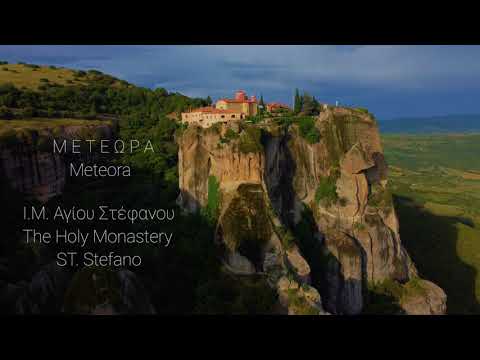
Agios Stefanos Monastery
Read moreShow less
The first hermits (9th–11th century). It is impossible to say exactly when the first monks climbed the rocks of Meteora — they left no visiting cards. But historians date the arrival of the hermits to the 9th century. They were ascetics in search of ἡσυχία (hesychia) — sacred stillness, a state of absolute inner peace in which, they believed, one could hear the voice of God.
They lived in natural caves and crevices, climbing up on rope ladders and wooden pegs driven into the stone. Their way of life was severe beyond measure: a meagre diet — wild herbs, fruit, occasionally bread hauled up from below in a basket; water from rainwater springs; prayer — twelve hours a day or more. They came down only on Sundays, to pray in the church of the village of Stagoi (today's Kalambaka) and to receive modest help from the peasants.
The golden age (14th–16th century). The man who changed everything. In the fourteenth century a figure appeared without whom Meteora would have remained merely rocks with caves — the monk Athanasios Koinovitis, later known as of Meteora. Around 1344, with fourteen companions, he climbed to the summit of the highest rock — "Platys Lithos" (the Broad Stone) — and founded there the monastery he dedicated to the Transfiguration of Christ. It was Athanasios who gave the whole complex the name Meteora — «suspended in the air».
His successors kept building. By the sixteenth century more than twenty monasteries crowned the rocks. Each was built as a fortress: the only way up was a rope ladder or a lifting net (dikti). Goods, supplies, building materials — everything was hauled up in woven baskets by winch. To travellers' famous question «How often do you replace the rope?» the monks, so the story goes, replied with disarming calm: "When the Lord wills it to break."
The Ottoman period (15th–18th century): guardians in the clouds. After the fall of Constantinople in 1453 and the establishment of Ottoman rule in the Balkans, the monasteries of Meteora took on a significance far beyond religion. They became cultural refuges — repositories for everything that might have been destroyed down below: manuscripts, theological treatises, chronicles, icons, liturgical books.
The monks copied texts, taught young people from the surrounding villages to read and write, and kept in contact with other centres of Orthodoxy — with Mount Athos, the Patriarchate of Constantinople and Serbian and Bulgarian monasteries. In a sense, Meteora served as a medieval «cloud storage» — in the literal, not the digital sense: the archives were kept in the clouds, several hundred metres above the plain. While empires changed hands and villages burned below, up above the monks went on copying the Gospels.
Decline and revival (17th–20th century). By the seventeenth century the number of monasteries and monks began to dwindle. The causes were many: earthquakes destroyed buildings, robbers sometimes even reached the summits, the young left for the cities, and maintaining monasteries on the rocks demanded extraordinary effort. By the beginning of the 20th century, of the twenty-four communities only a handful were still active — the rest were abandoned, their walls slowly dissolving back into the stone from which they had come.
The turning point came in the middle of the twentieth century: systematic restoration began, roads were built up to the monasteries and stone staircases were cut into the rock (until then the only way up had been by nets and rope ladders).
Cloud storage · 14th century
In a sense, Meteora served as a medieval «Cloud Storage» — in the literal, not the digital sense.
The archives were kept in the clouds , several hundred metres above the plain. While empires changed hands and villages burned below — up above, the monks went on copying the Gospels.
Meteora — What you will see
Six monasteries · the climbs · viewpoints · the spirit of the place
Practicalities and sensations — what awaits you on your visit.
Agia Triada Monastery
Read moreShow less
Meteora today. Of the twenty-four historic communities, six are still active: four for men and two for women. They are open to visitors and pilgrims — you can see frescoes, libraries of manuscripts, icons and ossuaries, and occasionally watch the monks going about their daily rhythm. But it is important to know: this is not an "open-air museum" but living monasteries. The liturgy is celebrated daily, bells ring, monks work in gardens and workshops — and they occasionally remind visitors, politely but firmly, that they are in fact guests . (For the dress code, opening times and other practical matters — see the «Questions & answers» section at the end of the page.)
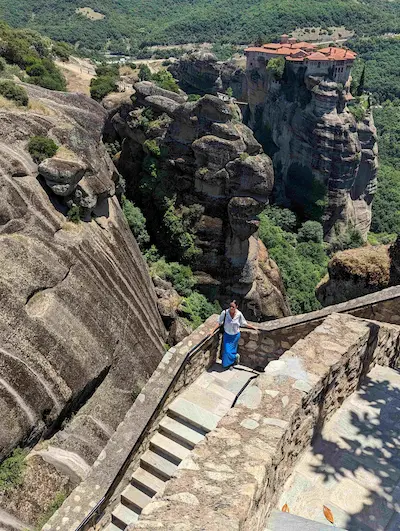
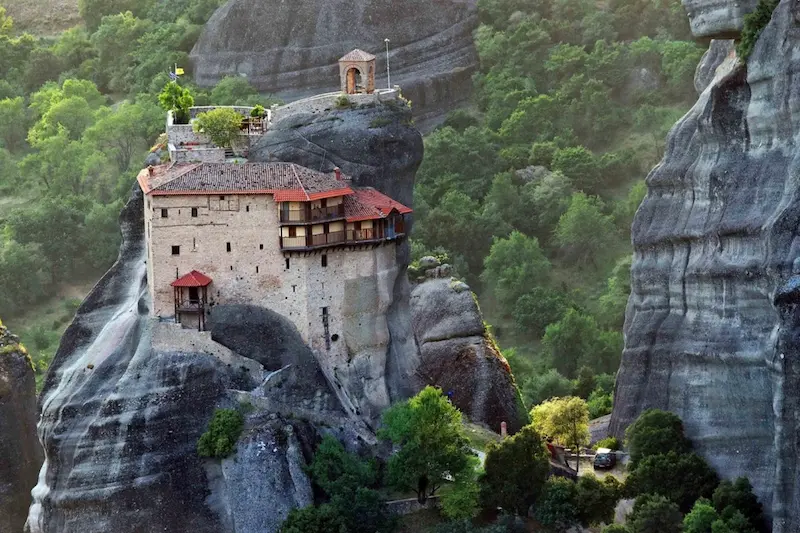
The climbs. This is one of the most common worries — and one of the least founded. An asphalt road with a car park leads to every monastery. From the car park to the entrance — 3–5 minutes up a comfortable stone staircase with handrails and resting platforms. This is not mountaineering, not a forced march, but a leisurely walk, accessible to people of any age and any level of fitness.
The viewpoints. Many of the finest viewpoints at Meteora are right by the road — no more than five steps from the car to the edge of a precipice — with railings, no fear — and a panorama you will never forget.
The philosophy of the place. Meteora is not simply a "sight" in the touristic sense of the word. It is a place where three forces meet: nature, seit sechzig Millionen Jahren am Werk; human will, which six hundred years ago defied gravity; and stillness — that singular stillness for whose sake the hermits climbed these rocks, and which has miraculously survived to this day, despite the tour buses and the souvenir shops. Time behaves differently here — it slows, it thickens, and suddenly you are standing at the edge of a precipice, looking down in silence, having forgotten why you wanted to reach for your phone.
Meteora — Impressions and details
Choosing the route · frescoes · rock pillars · no filter needed
The details from which the grandeur is woven.
Agios Stefanos Monastery
Read moreShow less
The choice of monasteries is yours, guided by the day's schedule. On a single visit you can realistically see between one and three, depending on your pace and your interests. I suggest the optimal combination so that you see the most without feeling rushed. Because Meteora is not about "ticking everything off the list", but about pausing, looking down from a height of 400 metres and grasping that people built all of this without a single crane — out of sheer stubbornness and faith.
Sometimes a single sign, a single detail is enough to grasp the scale of a place. At Meteora such details are everywhere: in crevices tens of millions of years old, in the silence of the monastery corridors, in the faces of the saints on five-hundred-year-old frescoes — still looking at you with the calm certainty of those who were here first and know that they will be here last.
These photos are not retouched. What you see on this page are real images, with no colour correction and no filters. At a certain point in Meteora the arguments end and quiet astonishment begins. The word "μετέωρα" means "to hover" — and when you see it with your own eyes, it becomes crystal clear why the legends arose, why the hermits sought solitude precisely here, and why Meteora appears on every list of places you must see at least once in your life.
A landscape that is architecture in itself. Nature worked here for sixty million years, the monks for six hundred. The fruit of their joint (if unintentional) creation is a monument to the power of collaboration — even if one of the collaborators has been at work for sixty million years.
Stone staircases and paths blend seamlessly into the natural contour — as if the rock itself had offered up the steps. In places you can still see the old rope mechanisms and lifting winches with which the monks carried goods and people to the summit over the centuries.
Frequently asked questions
At a glance — everything you need to know before your trip to Meteora.
This is not mountaineering — it is a walk. An asphalt road with a car park leads right up to each monastery.
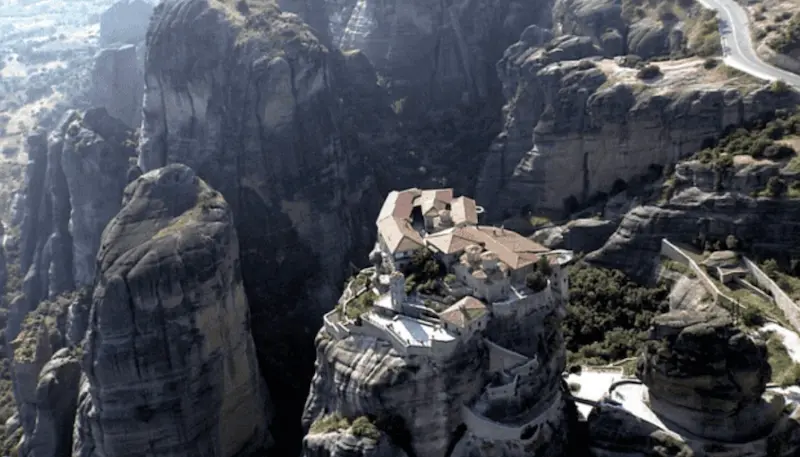
The climb usually takes 3–5 minutes up a comfortable staircase cut into the rock. To the monastery of Varlaam(in the photos) — wide steps, handrails, resting platforms.
The pace is adapted to you. Meteora is about the experience, not about speed.
I tell the story all the way to Meteora: the history and culture of Greece, mythology, the hermit monks, how the monasteries were built on the rocks without cranes. The storytelling turns the drive into part of the tour, and the journey flies by.
1.5–2 hAthens → Kamena Vourla
15–20 minKamena Vourla → Thermopylae
~1 hThermopylae → Meteora
3–4 hOn site: monasteries + viewpoints + lunch
~3 hReturn
On site — a full tour: commentary on the history of each monastery, the monks, the frescoes, the architecture. Viewpoints with breathtaking panoramas. Afterwards — lunch in a Greek taverna.
If there are up to 3 adults (+ max. 1 child) — we travel in a Škoda Superb. A saloon with a huge cabin, crucial on long drives: it is so roomy you can cross your legs.
Air conditioning Wi-Fi in the car Chilled water from the fridge
If there are up to 7 of you — Mercedes Viano.
More than that — a minibus.
The monasteries are active communities, and a dress code is compulsory:
For women
Skirt below the knee, shoulders covered
For men
Long trousers (no shorts)
If you have no skirt or sarong — no worries: wrap-around skirts are provided at the monasteries. Head coverings are not required for women. However, long trousers for men are compulsory — these are not provided, so leave the shorts at the hotel.
Usually 1–3 monasteries — enough for the impression to be deep rather than rushed. The choice depends on the day of the week (each monastery has its own schedule and closing days). I choose the best combination in advance.
Yes. For children Meteora is like stepping into a fairy tale: monasteries on rock pillars, staircases to the sky, views so spectacular that even the adults forget their phones. The history may not grip them — but the landscape and the sense of adventure always do. This is the kind of place a child comes back from wide-eyed and talks about for a week.
The drive is broken up by stops in Kamena Vourla and at Thermopylae, and the climbs are short — the format is comfortable for the whole family.
Lunch is in a traditional Greek taverna at the foot of the Meteora rocks. This is not a "tourist canteen" but a real place with home cooking: moussaka, lamb, fresh salads, local wine.
1–1.5 hat a relaxed pace · lunch not included · usually €15–25 per person
No, monastery entrance tickets are not included in the tour price.
5 €per monastery entrance
Tour price
For an exact quote, please write: how many people (children count too) and when you are arriving (the month at least).
Tap a button below to open a chat instantly — you don't need to save my number to reach me on WhatsApp, Viber or Telegram.
Bear in mind that roaming charges can get expensive
Meteora photo gallery
Click a photo to view it full size
1
Panorama
2
Rock pillars
3
Floating rocks
4
View from below
5
Myths & legends
6
Hermit retreats
7
Architecture
8
Golden age
9
The climb
10
Staircases
11
Viewpoints
12
Views
13
Details
14
Monasteries
15
Landscape
16
Traditions
17
Restoration
18
Symbols
19
Frescoes
20
In the rocks
21
Kamena Vourla
22
Thermopylae
23
Leonidas
24
Road
✦ Get prices
Contact Alex
For an exact quote, please write: how many people (children count too), when you are arriving (the month at least), and which tour you are interested in.
Tap a button below to start a chat — no need to save my number first